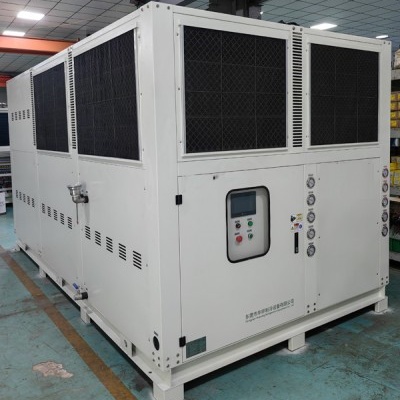
Air-cooled and water-cooled chillers are two of the most common types of cooling systems. While they serve the same primary function, they differ significantly in their operating principles, installation requirements, and ideal application scenarios.

Operating Principles
The primary difference lies in how they dissipate heat.
Air-cooled chillers use fans to draw ambient air across a condenser to cool the system. As the air passes over the condenser, it absorbs heat from the refrigerant, which is then circulated through the compressor to continue the cooling cycle.
Water-cooled chillers, by contrast, use water as the heat exchange medium. After the refrigerant is compressed, its heat is transferred to water via the condenser. This heat is then dissipated through a separate cooling water circulation system (typically utilizing a cooling tower).
Installation Requirements
Installation methods also vary between the two systems.
Air-cooled chillers are relatively straightforward to install since they rely on fan-driven airflow for heat dissipation. Their main requirement is a well-ventilated environment.
Water-cooled systems are more complex. They require additional components (like water cooling loops), occupy a larger footprint, and necessitate extensive plumbing connections. Because of this, air-cooled chillers are often the preferred choice for locations with strict space limitations, such as high-rise buildings.
Application Scenarios
Finally, their ideal use cases differ based on their cooling mechanisms.
Because air-cooled chillers rely on airflow to reject heat, they are best suited for outdoor installations or highly ventilated indoor spaces.
Water-cooled chillers rely on a dedicated water loop, making them ideal for indoor environments. They are commonly placed in dedicated mechanical rooms or large-scale facilities that require significant ambient temperature reduction, such as industrial manufacturing plants.
In summary, air-cooled and water-cooled chillers have distinct operational mechanisms, installation footprints, and ideal use cases. Selecting the right chiller ultimately depends on evaluating your facility's specific environmental conditions, space constraints, and overall cooling requirements.