leave a message
leave a message
If you are interested in our products and want to know more details,please leave a message here,we will reply you as soon as we can.
Submit

Application Fields

Home Application Fields

Industrial Chillers for Surface Treatment Processes

Industrial Chillers for Surface Treatment Processes

Jan 21, 2026


During surface treatment or machining, objects often undergo deformation due to external thermal loads, mechanical forces, or gravitational pull. The material’s internal structure generates restorative forces to resist this deformation. When the material cannot fully return to its original state, Residual Stress remains.


Traditional Stress Relief Methods

  • Thermal Aging: Annealing, normalizing, or soaking at temperatures below the tempering point.

  • Natural Aging: Exposure to environmental cycles (temperature fluctuations, sunlight, and rain) for a slow, natural release of stress.

  • Mechanical Stress Relief: Manual hammering or the use of Vibratory Stress Relief (VSR) equipment.


Modern Heat Treatment: "The Four Fires"

The core of modern metallurgical control lies in managing the Heating Temperature, Soaking Time (Holding Time), and Cooling Rate.

Technical Rule: A faster cooling rate leads to higher internal stress and increased material brittleness.

1. Annealing

  • Process: Heating followed by soaking and slow furnace cooling.

  • Purpose: Reduces hardness for improved machinability, refines the microstructure, and eliminates internal stress.

2. Normalizing

  • Process: Heating followed by soaking and cooling in still air at room temperature.

  • Applications: * Enhances the hardness and strength of low-carbon steel for better machining precision.

    • Refines grain structure and prepares the material for subsequent heat treatment.

    • Serves as the final heat treatment for non-critical components.

3. Quenching

  • Process: Rapid cooling in water or oil media.

  • Purpose: Significantly boosts hardness and strength.

  • Note: This process increases internal stress and must typically be followed by tempering to prevent cracking.

4. Tempering

  • Process: Reheating to a specific temperature followed by soaking and cooling.

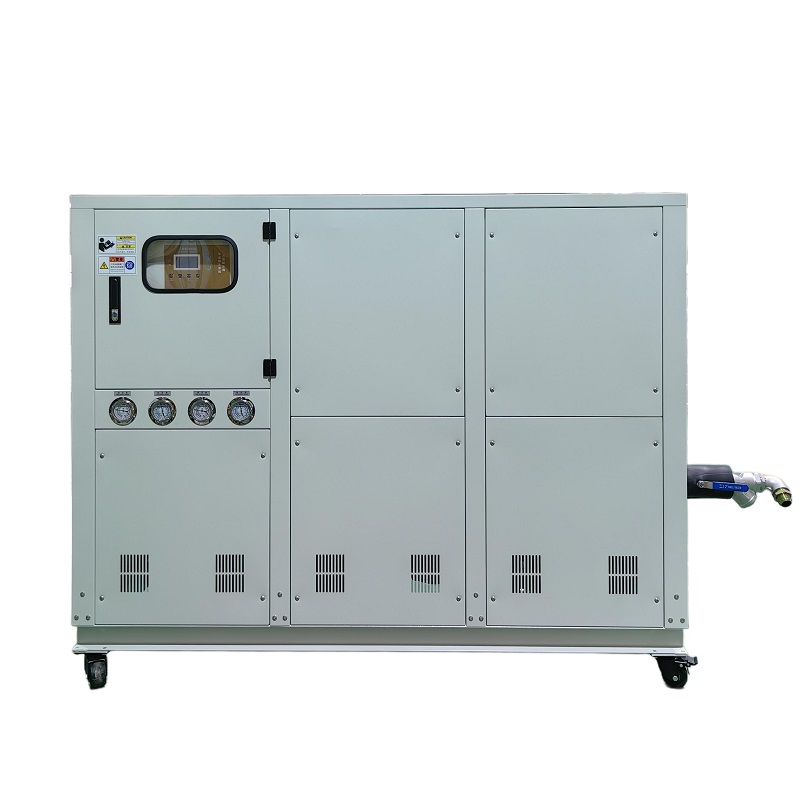
  • Industrial Application: Huaxiang large scale screw chiller units are widely utilized here to stabilize thermal cycles.

  • Effect: Eliminates quenching stress while improving toughness, wear resistance, and fatigue strength.

    • High-temperature tempering results in more stress relief and higher toughness, though hardness will decrease accordingly.


Advanced Specialized Processes

Quenching & Tempering 

A combination of Quenching + High-Temperature Tempering. This dual process provides the workpiece with excellent comprehensive mechanical properties, balancing strength and ductility.

Cryogenic Treatment

Used to further improve hardness and overall mechanical performance by transforming retained austenite into martensite. To achieve the precise sub-zero temperatures required, this process must be equipped with Yiyun chiller units for reliable and stable cooling performance.


leave a message

leave a message
If you are interested in our products and want to know more details,please leave a message here,we will reply you as soon as we can.
Submit
Contact Us:hxchiller@163.com

Home

Products

contact