留言
留言
如果您对我们的产品感兴趣并想了解更多详情,请在此留言,我们会尽快回复您。
提交

客户案例

首页 客户案例

Water-Circulating Cooling System

Water-Circulating Cooling System

Jul 29, 2026

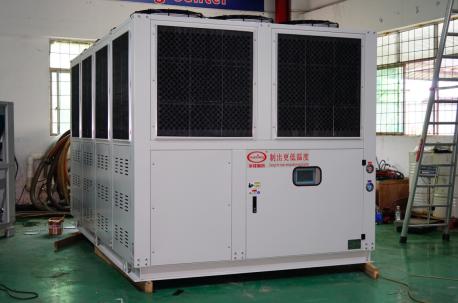
In modern large-scale infrastructure construction, especially in underground enclosed environments such as subway tunnels, highways, and bridges, the continuous high-load operation of construction equipment inevitably leads to the accumulation of massive amounts of heat. Taking the tunnel boring machine (TBM), a core piece of equipment for tunnel boring, as an example, its cutting tools cut through rock, and its main drive motor and hydraulic system continuously work within a confined space. If the heat generated cannot be dissipated in time, it will directly lead to equipment overheating protection, a sharp drop in mechanical efficiency, and even safety hazards. To address this demanding working condition, our company, leveraging its professional HVAC engineering design capabilities, has tailored a complete and efficient water-circulating cooling system for the construction site. This system uses an air-cooled screw chiller as the core cold source, supplemented by a chilled water circulation pump and a circulating insulated water tank. It seamlessly couples with the client's existing plate heat exchanger, cooling tower, circulating water pump, piping system, and water storage system, forming a gradient heat dissipation network that combines closed and open systems.


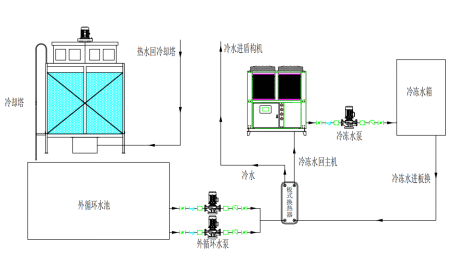
Its on-site application principle is based on heat exchange and phase change refrigeration technology: Air-cooled screw chillers produce 7°C or 10°C low-temperature chilled water, which is then pumped to the surface cooler of the fume hood via a chilled water circulation pump. Simultaneously, fresh air from outside the tunnel is forcibly introduced into the fume hood, allowing for thorough cross-heat exchange between the airflow and the low-temperature chilled water as it flows through the finned tube bundle of the surface cooler. This significantly reduces the fresh air temperature, with measured temperature differences exceeding 10°C. The cooled, dry air is then introduced into the tunnel boring machine's working face and personnel activity areas. This effectively absorbs radiant and convective heat from the tunnel boring machine's cutting tools, motors, and hydraulic stations, while also significantly reducing humidity and dust concentration within the sealed chamber. Meanwhile, the system's return water, carrying the absorbed heat, returns to the plate heat exchanger for secondary heat exchange with the circulating water on the cooling tower side, ultimately releasing the heat into the atmosphere. The circulating water, cooled by the cooling tower, is then resupplyed to the plate heat exchanger via a water tank storage system and a circulating water pump. This cycle repeats, creating a dynamic balance management of the on-site equipment's heat load. This comprehensive tunnel boring machine (TBM) cooling solution not only actively intervenes in the heat load on the equipment side, effectively curbing equipment failure rates caused by high temperatures, but also significantly improves construction and tunneling efficiency, while greatly enhancing the comfort and breathing environment of underground workers.


Currently, domestic subway tunnel projects under construction have clearly defined requirements for cooling the working environment, mandating the installation of adequate cooling systems and ensuring that the temperature difference between the supplied air after fume hood treatment and the original tunnel environment temperature is consistently maintained above 10°C. Our company's water-circulating cooling system fully complies with these mandatory standards. Furthermore, thanks to the high efficiency and energy-saving characteristics of the air-cooled screw chiller unit, the flexibility of its modular layout, and its fully automatic temperature control capabilities, its reliability has been successfully verified in several key urban subway projects, making it an ideal technical solution for dealing with high-temperature and high-humidity underground conditions. This system also boasts advantages such as convenient installation, low maintenance costs, and adaptability to extreme dust environments, providing a durable, stable, and environmentally friendly cooling source for large-scale mechanized construction in future urban underground spaces.


The main unit's cooling source equipment. The design flowchart is as follows:


The project leadership highly praised the design and emphasized that it provided a comfortable working environment for the subway construction tunnels.